![Voltaiq_Logo_Black_Transparent- 600.png]](https://1913583.hs-sites.com/hs-fs/hubfs/Voltaiq_Logo_Black_Transparent-%20600.png?height=42&name=Voltaiq_Logo_Black_Transparent-%20600.png)
1. Working with large amounts of data
Voltaiq AI is able to process thousands of records, tests, and metadata in seconds. It can quickly identify correlations and outliers, and humans can apply judgement to determine what is worth further investigating. In this example, 50,000 tests from a manufacturing lot were analyzed by Voltaiq AI to highlight any interesting observations. It determined a high degree of correlation between dQ/dV peak hysteresis and capacity.
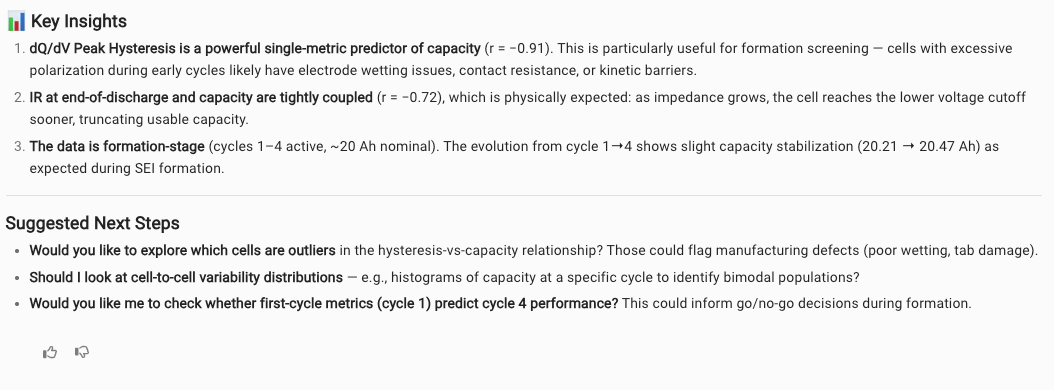 Figure 1. Output of asking Voltaiq AI to "find interesting observations in this data" of a dataset of 50,000 formation tests.
2. Recognizing patterns in high dimensional data
Your cells often have accompanying metadata consisting of build data, process data, or traceability data. It can be difficult to analyze this data because there is so much of it that it can be overwhelming to even know where to begin. For example, if your data consists of thousands of measurements, it could take weeks to figure out that the offending root cause is the 10th sensor in the winder, or operator X.
The advantage of Voltaiq AI is being able to recognize trends and correlations between thousands of metadata and electrochemical metrics. For example, you could ask Voltaiq AI to find what build parameters are most closely associated with low capacity or high DCIR.
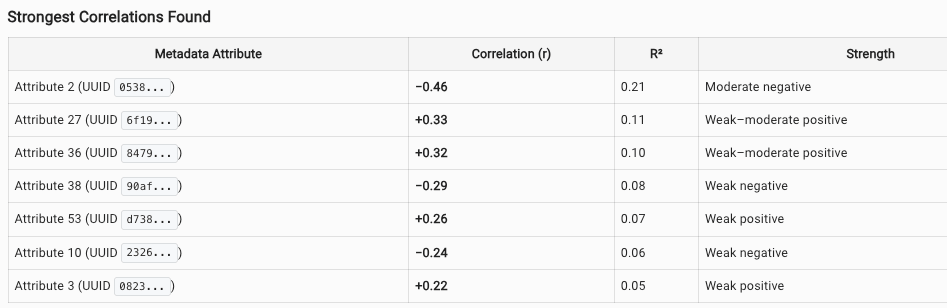 Figure 2. Output of asking Voltaiq AI to "find correlations between metadata and performance of cells"
3. Statistical Analysis
Unsure if your sample size is large enough? Which t-test or z-test should be used? How do you know if the difference is real or if it's random chance? Voltaiq AI can do statistical testing and analysis to give you the confidence needed to present and defend your results.
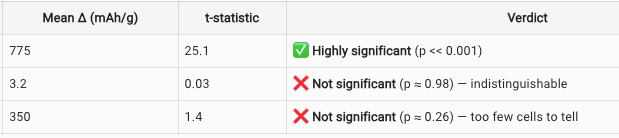
Figure 3. Output of asking Voltaiq AI "how do I know it's a real difference and not random chance"