![Voltaiq_Logo_Black_Transparent- 600.png]](https://1913583.hs-sites.com/hs-fs/hubfs/Voltaiq_Logo_Black_Transparent-%20600.png?height=42&name=Voltaiq_Logo_Black_Transparent-%20600.png)
Introduction
A pack that meets voltage and thermal targets when new may no longer maintain those margins as impedance increases and heat generation rises over time. Examining performance at BOL alone is insufficient. Evaluating performance at EOL is equally critical.
One solution to this issue is to build a system-level model in Voltaiq Studio that allows pack behavior to be evaluated across the full life cycle. This model can be populated with your existing ageing data in Voltaiq.
BoL vs. EoL Comparisons
OEM requirements are rarely defined at beginning-of-life. Voltage windows, power capability, and thermal limits are typically specified at defined state-of-health (SoH) thresholds. A pack that meets targets when new may exceed margins once capacity fades and resistance increases.
By applying measured ageing data (resistance growth and capacity retention) to electro-thermal ECM models in Voltaiq Studio, pack behavior can be simulated at both BOL and EOL under identical dynamic drive cycles (Figure 1).
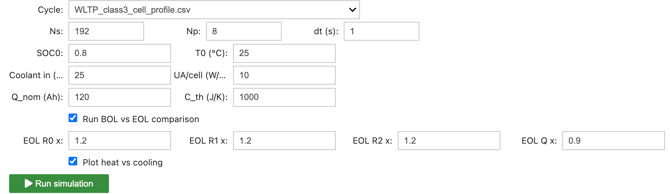
Figure 1. Simulation tool built in Studio from measured ageing data
This enables direct comparison of voltage sag, temperature rise, and available power across life (Figure 2). Rather than assuming linear degradation, cell developers can quantify how ageing shifts pack-level constraints and identify when and where performance margins erode.
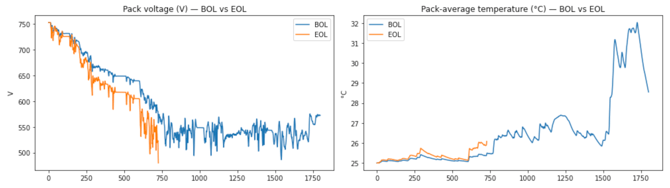
Figure 2. Simulated pack voltage and temperature at BoL vs. EoL
Design for Margins at EoL
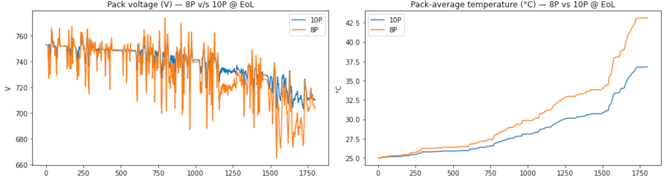
Ageing does not impact pack performance uniformly; its effect is shaped by architecture. The number of cells in parallel determines per-cell current density, while cooling effectiveness governs whether ageing-driven heat growth remains manageable under sustained load.
As shown in Figure 3, differences in parallel configuration at EOL produce a measurable divergence in both voltage stability and temperature rise under identical drive cycle conditions. Lower parallel count increases electrical and thermal stress, reducing lifetime performance margin.
Key Takeaways
-
Beginning-of-life performance does not guarantee end-of-life margin.
-
Pack architecture and thermal management amplify the impact of ageing.
-
Using Voltaiq to integrate ageing data into simulation enables lifetime-aware design decisions.
-
Early visibility into margin erosion reduces warranty and field risk.