![Voltaiq_Logo_Black_Transparent- 600.png]](https://1913583.hs-sites.com/hs-fs/hubfs/Voltaiq_Logo_Black_Transparent-%20600.png?height=42&name=Voltaiq_Logo_Black_Transparent-%20600.png)
Summary:
It can be difficult to identify the exact causes of performance differences because there could be dozens (or more) of parameters to investigate. This is a computational problem best solved with AI tools. The Voltaiq AI chat interface is ideal for this because it's iterative, enabling drilling down to root cause.
Why does this matter?
The faster you identify a problem, the faster you can solve it. In R&D this translates into faster timelines and faster iterative development cycles. In manufacturing, this translates into higher yield and higher throughput.
Manual approaches are slow, error-prone, and require substantial expertise. In contrast, entering a prompt in Voltaiq AI is fast, based on your own data, and has context about your organization.
Use case example walkthrough
Problem:
In this example, let's use the most common problem there is: low capacity cells. Low discharge capacity is measured during the formation cycles, and we need to determine the likely root cause.
How to approach it manually:
- Analyze 5 Whys, fishbone diagrams, and FMEA docs for ideas on potential causes
- For each cause, find the associated test data and plot the build data in a scatterplot
- For each cause, visually analyze if there is a relationship, or ideally, fit a trend line and calculate correlation coefficient
- Rank the most likely causes, and then further investigate 1 by 1. Keep drilling down to determine the root cause
How to approach it with Voltaiq AI:
- Input the prompt "what build parameters are likely causing low capacity?"
- Keep iterating by asking more questions to determine the root cause
Walkthrough explanation:
1. Input the prompt "what build parameters are likely causing low capacity?"
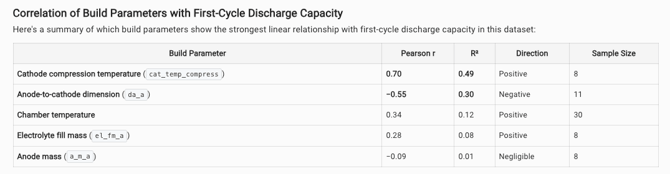
Voltaiq AI takes the selected test data, links it with the associated build data, and then calculates a correlation coefficient for each relationship. In this example, low capacity was identified as the electrochemical metric of concern. Voltaiq AI then calculates the correlation between capacity and build parameter 1, capacity and build parameter 2, ..., and capacity and build parameter N.
Importantly, this is essentially the same as the manual process steps 1 through 3. This is condensed and faster because this is a data problem well suited for computational analysis.
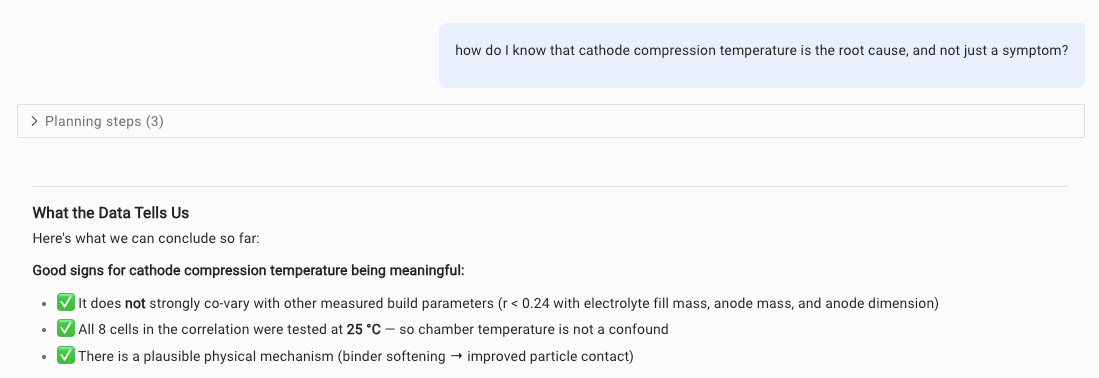
2. Keep iterating by asking more questions to determine the root cause
One of the advantages of using Voltaiq AI is that it can surface surprising or interesting observations. It is possible to follow these threads to a satisfying conclusion by continuing to ask questions. These explorations can happen in minutes, and don't require additional planning, analysis, or data wrangling like a manual approach would. A common usage pattern is to ask Voltaiq AI to defend (or poke holes in) a certain interpretation. This builds trust that the root cause was identified.