![Voltaiq_Logo_Black_Transparent- 600.png]](https://1913583.hs-sites.com/hs-fs/hubfs/Voltaiq_Logo_Black_Transparent-%20600.png?height=42&name=Voltaiq_Logo_Black_Transparent-%20600.png)
Summary:
One of the interesting insights about the battery industry is that if that if you have 10 people doing a pulse analysis, you'll have 11 different ways of analyzing the results. This is an ideal use case for Voltaiq AI chat, because you can iteratively tailor the analysis to meet your specifications exactly.
Why does this matter?
Most pulse analysis scripts suffer from reusability and brittleness challenges. It might work for a very specific test protocol, but as soon as the protocol changes or requires a different calculation for DCIR, it is no longer accurate.
Use case example walkthrough
Problem:
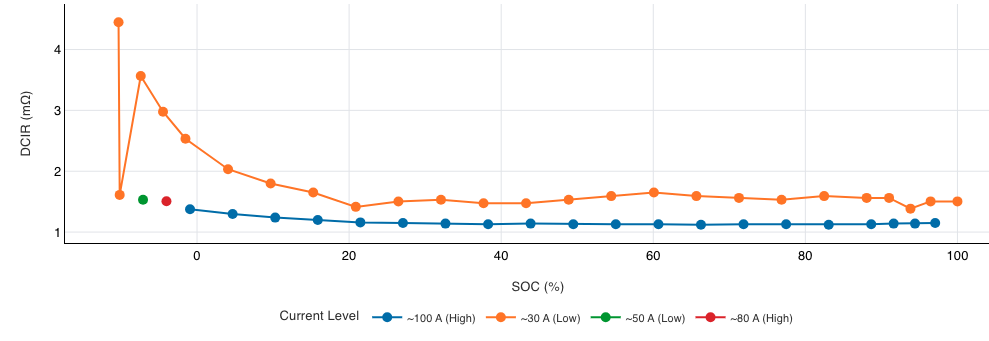
In this example, let's suppose we have data for a pulse test. We need to calculate the DCIR at each SOC.
Pulse analyses are notoriously tedious and time-consuming. For extra realism, let's assume that someone will ask to change DCIR calculation methodology will change in the near future.
How to approach it with Voltaiq AI:
- Prompt to identify the pulses. Give context on what an expected pulse looks like.
- Prompt to calculate the DCIR. Give context on how the DCIR should be measured.
- Prompt to calculate the SOC. Give context on how SOC should be measured.
Walkthrough explanation:
1. Prompt to identify the pulses. Give context on what an expected pulse looks like
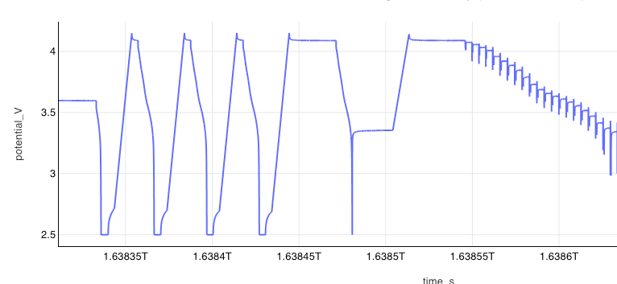
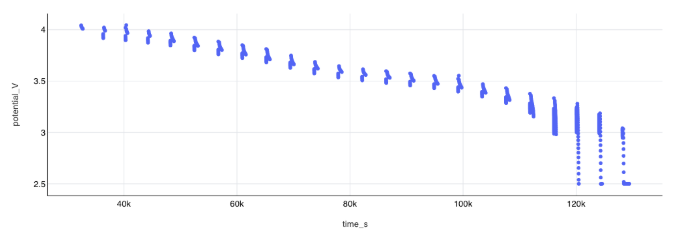
The key to performing pulse analyses is to accurately identify the pulses. This is accomplished by giving the AI context on what a pulse is. In this example, the pulses are discharges that are relatively short in duration (relative to do the C/3 discharges in the beginning of the protocol) and occur in pulse trains. These two pieces of information are important for identifying all pulses, especially the last three pulses that hit the lower cut-off voltage limit.

2. Prompt to calculate the DCIR. Give context on how the DCIR should be measured.
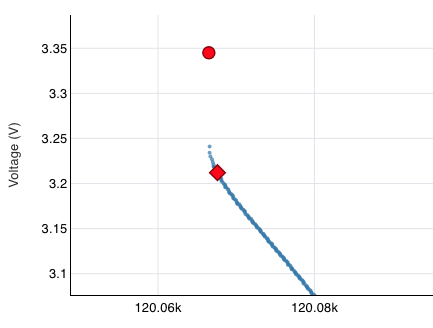
DCIR calculation varies significantly between organizations and engineers. Giving the AI context on how you want your DCIR to be calculated is the key to getting the results you expect. For example, it is common to calculate DCIR for pulse analyses at 1s, 10s, 30s, 60s, and more. It can be helpful to ask the AI to mark these points in red to confirm that it is calculating it to your specifications.

2. Prompt to calculate the SOC. Give context on how SOC should be measured.
A common misstep during pulse analysis is not giving the AI information on how SOC should be calculated. It is highly recommended to tell the AI to use the full DOD discharges at the beginning of the protocol as the reference capacity for SOC calculation.