![Voltaiq_Logo_Black_Transparent- 600.png]](https://1913583.hs-sites.com/hs-fs/hubfs/Voltaiq_Logo_Black_Transparent-%20600.png?height=42&name=Voltaiq_Logo_Black_Transparent-%20600.png)
Charge-discharge cycler equipment is a significant investment that requires dedicating valuable time to test, form, qualify, or validate batteries. It’s important to maximize the value of that equipment and those cycles. In later posts, we’ll show that there is more insight to your test data than just capacity, energy and efficiency.
Unfortunately, many organizations use data logging conditions that are arbitrarily chosen without careful consideration. A common situation is when someone writes an initial protocol, and subsequent protocols are copy-and-paste modifications that retain the arbitrary, unoptimized configurations. These “branches” can often persist for years, causing unnecessary (or insufficient) data collection that impedes analysis.
Use these recommended logging conditions to standardize and optimize test protocols. These best practices generate rich datasets that maximize information extracted from charge-discharge cycling, while minimizing the data volume recorded.
General purpose testing: For most general purpose testing use cases, such as cycling, cycling with intermittent RPTs, rate tests, pulse tests, and long term storage tests, Voltaiq recommends the following logging conditions:
- During constant current (or power) charge and discharge steps, record data at fixed voltage increments. This is important to obtain clean differential capacity plots (dQ/dV vs V).
- During steps immediately following a charge or discharge, record data at a fixed time interval. This is important for calculating metrics such as internal resistance after charge-discharge, or the impedance at a set frequency. The duration of the time interval is based on analytical needs. For reference, commonly used values in industry for internal resistance measurement are 10s (0.1Hz), 30s, & 60s.
Precise modeling use cases: Use cases that require precise modeling of a battery’s dynamic responses, such as relaxation or polarization, will benefit from the following modification:
- Record high frequency time series data around the onset or termination of charge or discharge, for a meaningful time relevant to the time constant (𝜏) of the mechanism being modeled. For reference, typical sampling frequencies range from 1-100Hz. It is important to ensure that the logging frequency should be high enough for the cell model under static and dynamic loads.
- Outside of charge and discharge steps, the above general purpose recommendations continue to apply.
Standard recording conditions for cell testing
- On rest
- General recommendation: dt = 10 seconds
- Allows calculation of a fixed frequency (0.1 Hz) IR loss measurement
- If early-stage rest information is important — e.g. highly accurate ohmic or charge transfer resistance measurements — a two step rest should be used with the first step using dt ≤ 1 second, and the second step using dt ≥ 10 seconds.
- For extremely long duration tests that last several months or years, it may be desirable to use larger dt values. A common industry rule of thumb is tests shorter than 3 months are logged at dt=10s, tests between 3 months and a year are logged at dt=30s, and tests lasting over a year are logged at dt=60s.
- On charge/ discharge (non-CV)
- General recommendation: dV = 5mV is sufficient for most Li-Ion use cases
- This is important for obtaining clean differential capacity plots (dQ/dV vs V).
- Cyclers with sufficiently high resolution in a noise-free environment can record at dV = 1-2mV. This can be useful for research use cases.
- On charge/ discharge (CV)
- General recommendation: dI = ROUND ((Max Current - Cut Off Current) / N)
- N = 20 is a typical value for logging CV. Larger values of N should be used if trying to model a mechanism tied to CV current decay.
- For example, for Max Current = 5A & Cut Off Current = 0.1A, the delta current logging interval dI = 0.25A
- if dI logging isn’t possible, an alternative is to log with dt = 10 seconds.
Common challenges
A common scenario is for test technicians to combine multiple logging conditions together, such as dt and dV, due to competing requirements. It is important to note that combining multiple logging conditions can cause overlapping samples, often resulting in noisy test data due to cycler resolution, noise, and divide by zero conditions for computations like differential capacity (dQ/dV).
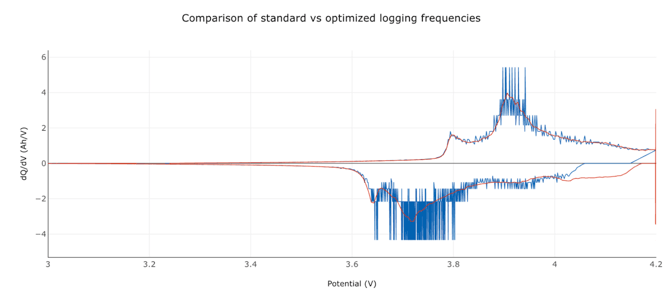
While it is best practice to avoid overlapping recording conditions in the first place, Voltaiq fortunately has built-in capabilities to smooth messy or noisy data that was recorded with suboptimal logging conditions.
Module and pack, & other advanced logging conditions
For module and pack cycling
- On charge/ discharge (non CV), the dV should be set so that approximately 100-1,000 data points are logged between the bottom to the top of the cycle.
- For example, for a 420V pack cycled from 300V to 400V, the recording condition should be set to dV: 0.1V - 1V
For cyclers that force you to set global logging conditions regardless of step type
- Option 1: For cycling that does not include constant voltage steps
- dV = 5mV is sufficient for most Li-Ion use cases
- Enables clean differential (dQ/dV) capacity plots, but limits usefulness of IR loss measurements on rest
- Option 2: Alternative option that logs more data and also require post processing to smooth
- dV = 5mV is sufficient for most Li-Ion use cases
- dt = 10 seconds
- Enables clean differential capacity plots, and also fixed frequency IR loss measurement
- Requires post processing for smoothing
If the cycler has combination CCCV step type
- Option 1: Use the separate CC and separate CV steps instead. Optimize each step individually using the above guidelines.
- Option 2: If the CCCV combination type step is strictly required,
- dV = 5mV is sufficient for most Li-Ion use cases
- dI = ROUND ((Max Current - Cut Off Current) / N)
- N = 20 is a typical value for logging CV. Larger values of N should be used if trying to model a mechanism tied to CV current decay.
- For example, for Max Current = 5A & Cut Off Current = 0.1A, the delta current logging interval dI = 0.25A
- OR dt = 10 seconds if dI logging isn’t possible