![Voltaiq_Logo_Black_Transparent- 600.png]](https://1913583.hs-sites.com/hs-fs/hubfs/Voltaiq_Logo_Black_Transparent-%20600.png?height=42&name=Voltaiq_Logo_Black_Transparent-%20600.png)
1. The Classic: Capacity Retention
The most common and ubiquitous way measure battery life.

2. Total Cycle Time Retention
Helps accurately answer the common question, 'how much longer?'

3. DCIR Growth
Quantify the impact of self-heating and other losses.

4. Average Charge Voltage Growth
Important for quantifying impact on charging in real-world applications.

5. Pre-discharge OCV
Measures the OCV before the discharge step of each cycle occurs.

6. Voltage Efficiency Retention
Voltage efficiency, or average discharge voltage / average charge voltage, can be an easy way to summarize rate performance degradation.

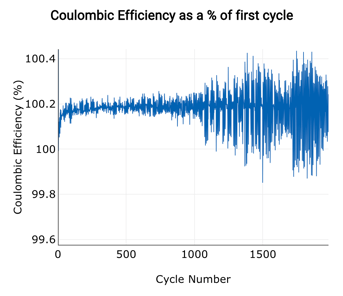
7. Coulombic Efficiency Retention
Coulombic efficiency can sometimes be >100% due to mismatches between charging and discharging, and cycling hardware limitations. However, looking at the total envelope can reveal insights in its degradation over cycling.
8. CV Charge Capacity Growth
CV charge capacity growth shows the amount of charging performed in the CV portion of the charge, instead of the CC portion. This can be useful for studying rate capability.

Haven't created a plot based on the first reference cycle before? Follow the tutorial steps here!